
The Chefs Behind the Dish You Haven’t Ordered Yet
Before the queue, the crowded tables, and the inevitable argument over what to order, there are the chefs figuring out what belongs on the menu.
Manam seems to come with a queue as part of the concept. You arrive hungry, put your name down, and spend the wait watching people who had the good sense to arrive earlier eat your future lunch.
For a generation raised on Barrio Fiesta, Manam feels like a contemporary answer to the same question: where do we take the foreign visitors and balikbayan relatives for Filipino food? You order generously, and then you find out everyone has opinions about Sinigang.
Behind that familiar experience sits considerably less familiar work. A dish has to survive more scrutiny than “masarap” before it becomes something you can order.

Sang Hyun Ong, Danielle Tensuan, and Rolfe Benedict Salamat are among the people conducting that scrutiny. All three are Enderun Colleges Culinary Arts graduates working in research and development at The Moment Group, the company behind Manam.
Their work involves developing food, certainly. It also involves making sure other people can prepare it consistently, in kitchens equipped to produce it, at a cost that allows the restaurant to keep serving it.
Sang: Two openings and a wedding
As Head of Research and Development, Sang leads product development across Moment’s brands. In 2024, that responsibility came with a particularly crowded calendar.
Manam at the Triangle opened in January. Sang got married in May. In July, her team helped open hayop ni Manam, The Moment Group’s Filipino restaurant in Singapore and an overseas sibling to Manam. Its name uses hayop, literally “beast” or “animal,” in the admiring Filipino sense of something outrageously good. An ambitious name. The food would have to hold up its end of the bargain.
As calendars go, hers was making a fairly aggressive argument against free time.
Her team developed recipes, planned kitchens, and conducted training and pre-opening activities for both concepts. Singapore was the group’s first international restaurant opening, bringing another level of coordination. Initiatives for its other brands had not politely excused themselves for the occasion.

Sang Ong with the team in front of hayop ni Manam in Singapore, where their work brought together recipe development, kitchen planning, and staff training for The Moment Group’s first international restaurant opening.
“Having a solid team and a well-oiled system was crucial,” Sang says.
It was a career she had not pictured when she entered Enderun.
Her family was in hospitality, and she expected to help manage operations after graduation. She completed her BS International Hospitality Management degree, specializing in Culinary Arts, in 2013. Internships at Amanpulo in Palawan and Le Pont de L’Ouysse in France gave her an early understanding of kitchen life, along with independence, grit, and resourcefulness.
Moving from the family hotel business into R&D was nevertheless “honestly overwhelming.”
After years concentrating on one property’s daily operations, she had to learn the systems of multiple kitchens and the details behind their menus. Corporate decision-making also required an adjustment from the family business.
Kitchen management occupied only a brief part of her education. Food costing and kitchen efficiency now feature in her daily work. The less glamorous parts of a syllabus become surprisingly interesting once someone is depending on you to get them right.
“People think corporate work is easier than restaurant operations,” she says. “It might be less physically taxing, but it presents a different realm of challenges.”
Dani: The career you have to know exists
For Danielle Tensuan, now an R&D Coordinator at Moment, the ambition began while she was still an Enderun student.
The 2025 Culinary Arts graduate first heard about the field through Enderun’s Office of Career Services. The name suggests forms, appointments, and advice about making your résumé fit on one page. In her case, it supplied something more consequential: an idea of what she might actually want to do.
She imagined working abroad before eventually entering R&D. An offer from Chef Miko Calo changed the itinerary.
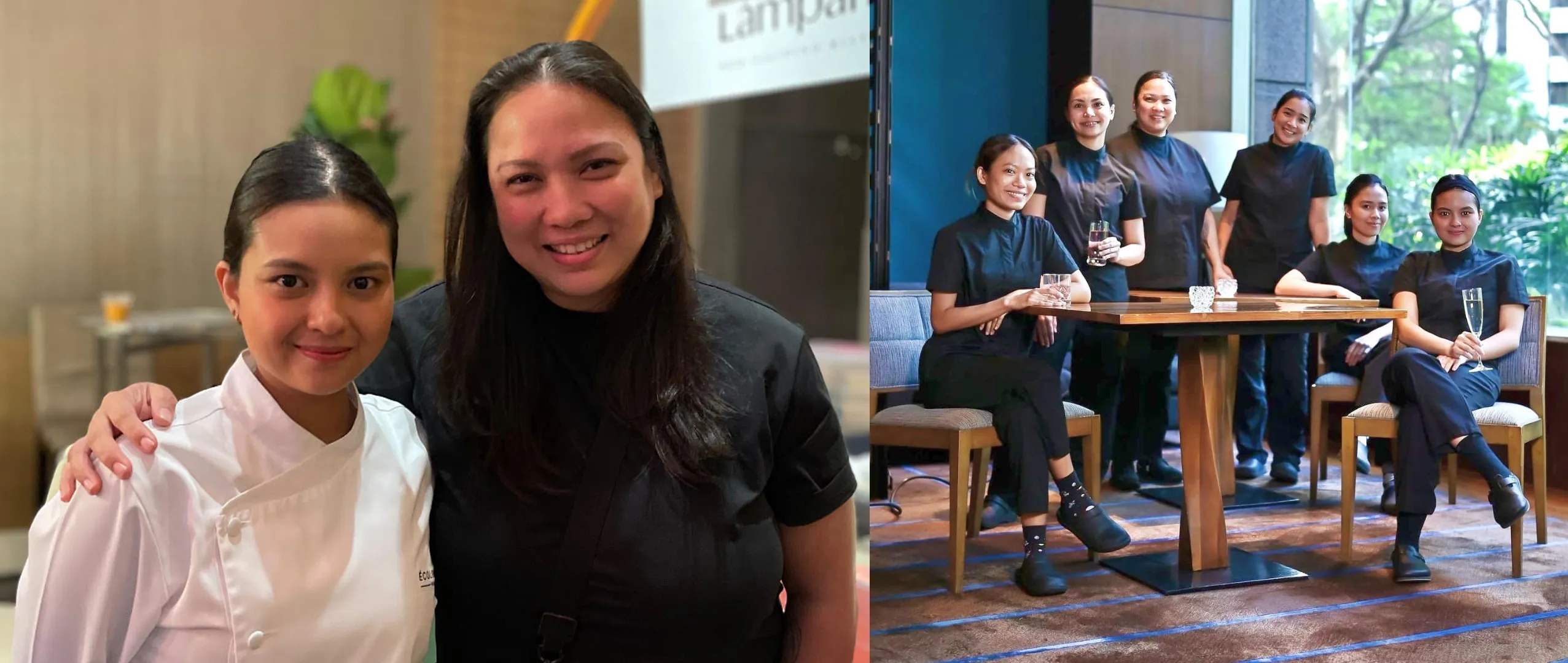
Danielle Tensuan with Chef Miko Calo and the all-female culinary team, where she developed the confidence to speak up and expect equal opportunities and respect in the kitchen.
Calo had trained at Ferrandi in France and worked in Joël Robuchon’s kitchens, including on the opening team of his Singapore restaurant, which went on to earn three MICHELIN Stars. She later became chef and co-owner of Metronome in Makati. For a young cook, an offer from someone with that background gives the plan to leave the country some serious competition.
Dani stayed. Her experience included Chef Miko’s residencies, Helm by Josh Boutwood, and Papillon in Salcedo Village. Papillon, now MICHELIN Selected, carries another Enderun connection: its head chef and owner, Chef RJ Ramos, is a fellow alumnus. One graduate’s early career had brought her into another’s restaurant venture.
Dani had considered herself a hot-kitchen person. Pastry received rather less attention during college. While working under Chef Miko, she was asked to assist the pastry chef and discovered an interest she had not expected.
The discipline demanded greater precision, patience, and organization. Her career had quietly declined to honour the boundaries she had set for it.
That proved useful. At Moment, she assists with recipe development across the hot kitchen, cold kitchen, and desserts. She also documents the team’s work and prepares dishes for Managing Partner tastings and photo and video campaigns.
The harder adjustment has been learning to trust herself.
As the team’s youngest member, she is conscious of having less experience than her colleagues. Yet developing new dishes requires her to exercise creativity and believe in her own judgment.
Experience helps build confidence. Unfortunately, some confidence is also required while you are still acquiring the experience.
The people you keep asking
Working under Chef Miko as part of an all-female culinary team helped Dani develop a professional voice. She learned to be fearless in a male-dominated industry and to expect the same opportunities and respect as anyone else in the kitchen.
There is, inevitably, that mildly irritating piece of career advice: it’s not what you know, it’s who you know. Dani’s experience gives it some credibility, though the kitchen still expects you to know what you’re doing.
She began meeting industry professionals as a freshman. Ms. Bel Castro helped her build connections and prepare for working life. Stern and quick with her observations, she can deliver several thoughts before you have finished processing the first. Somehow, you leave the conversation a little wiser, with a more open mind and a wider view of what you could become.
Chef Suzette Montinola remains someone Dani turns to for career guidance. A quiet, steady presence in Enderun’s Culinary Arts program, she has shaped young chefs with little fanfare. Her influence becomes clear in relationships like this one, where a graduate continues to seek her counsel beyond the classroom.
Dani is equally clear about what those connections cannot replace: experience in an operational kitchen.
“There is so much more than working in operations! However, I still strongly believe in gaining operational experience before doing anything else because it will be your basis for anything else that you do moving forward.”
Rolfe’s introduction to professional cooking makes that point rather concrete. It began before he had graduated, with an hour to prepare for lunch.
Rolfe: An hour before service
Today, Rolfe is an R&D Officer developing dishes for OOMA and 8Cuts. His first professional role was at Lazy Oeuf, Chef Miko’s pandemic takeout concept, while he was still an Enderun student.
He had no prior kitchen experience and had spent two years without laboratory classes. Now he was working in a professional kitchen while the team adapted to changing lockdown restrictions.
When lunch and dinner service eventually began, the amount of preparation surprised him. In the entremetier section, he prepared sauces, crisps, and side dishes to accompany fish and meat. Everything came from scratch, every day.
He had an hour before lunch service.
The small things on a fine-dining plate, it turns out, can consume a substantial part of your morning.

Rolfe Salamat with the kitchen team at Metronome, where his work as a commis chef strengthened his discipline, attention to detail, and respect for ingredients.
Working as a commis chef at Metronome taught him that building flavour allowed no shortcuts. Restraint mattered. So did cleanliness, organization, and enough backup preparation for a service that might exceed the expected guest count.
“One lesson that has stayed with me is that your station is a reflection of your thoughts,” he says.
A disorganized station was often a sign that he needed to reorganize his thinking, too.
He graduated in July 2022 with a degree in International Hospitality Management, specializing in Culinary Arts, and joined Moment in 2023. R&D sessions with Chef Miko had drawn his interest in the meantime. Watching an idea become a product revealed another way to work with food.
At Moment, he began learning what surrounded that process: food costing, staff training, recipe writing, photoshoots, competitor checks, and focus group discussions.
The French techniques he had learned at Enderun and practised at Metronome remained useful. The conditions under which his food had to succeed had changed.
A good dish has to travel
On the line, Rolfe had learned to prepare food carefully under the immediate pressure of service. In product development, he also had to consider how a dish would work in other people’s hands.
“A recipe can be great in theory, but if it cannot be consistently replicated by many people, then its value is limited,” he says.
A written recipe becomes part of the product. It must communicate what the developer knows well enough for other cooks to reproduce the result. Training matters for the same reason. The successful tasting is only the beginning.
Supply problems add another complication. Rolfe describes testing alternatives, exploring suppliers, and adjusting raw ingredients while protecting quality and consistency across stores. A replacement cannot simply solve a purchasing problem. It has to work in the food.
His involvement in hayop’s Singapore opening extended that challenge beyond the kitchen. Different produce, price points, customer preferences, and market conditions required him to reconsider his assumptions.
“Good food is not simply about the ingredients available, but about understanding the people, culture, and market you are creating it for.”
The job also required him to become more patient and deliberate in communicating with different personalities. Developing the dish and getting people to work together on it were related responsibilities. Neither could be settled entirely at the stove.
Success, with dinner included
The work has changed what all three want from their careers.
Sang once associated success with fine dining, extraordinary dishes, expensive menus, and opportunities abroad. She still values those achievements. But the chefs she admires most remain humble and hungry to learn, however much they have accomplished.
Dani once measured success through working in top restaurants. Now, being happy in her environment and feeling secure in her work carry greater weight. Operational life had meant missing family milestones and holidays, and confronting how much of herself she could give to the profession.
Rolfe had imagined working at a Michelin-starred restaurant overseas. He now wants a career that keeps him involved with food while allowing room for life outside work. He also finds satisfaction in sharing knowledge that other people can use after his part in a project has ended.
For Sang, almost a decade in R&D has not diminished the pleasure of exercising her creativity. There was no single moment when she decided it would become her long-term career. She enjoyed the work and kept doing it.
Asked what she would tell herself in her first year at Enderun, she offers this:
“Live more and worry less. You’ll eventually land a career that allows you to create dishes, travel for work and leisure, and still be home in time for dinner with your family.”
Back at Manam, someone is still waiting for a table. The recipes, preparation, and training these chefs helped put in place allow another team to serve the next guests.
That is part of the achievement, too. Creating food that keeps working when you are no longer in the kitchen.
The chef gets to sit down for dinner, too.
Related Stories

Articles
How Do I Stand Out as a Job Applicant with Just a Diploma?
What makes an employer believe you can do the job? Jun Salipsip explores how projects, internships, and lessons from mis...
Articles
What Architects Lose When They Only Say Yes
PARTISANS co-founder Alexander Josephson explores design conviction, technology, and the business of architecture at End...
