
What Interior Design Demands Beyond the Render
In an era of instant AI renderings and Pinterest boards, an Enderun student’s internship at Royal Pineda+ reveals the technical discipline, sound judgment, and human understanding required to create spaces that truly work.
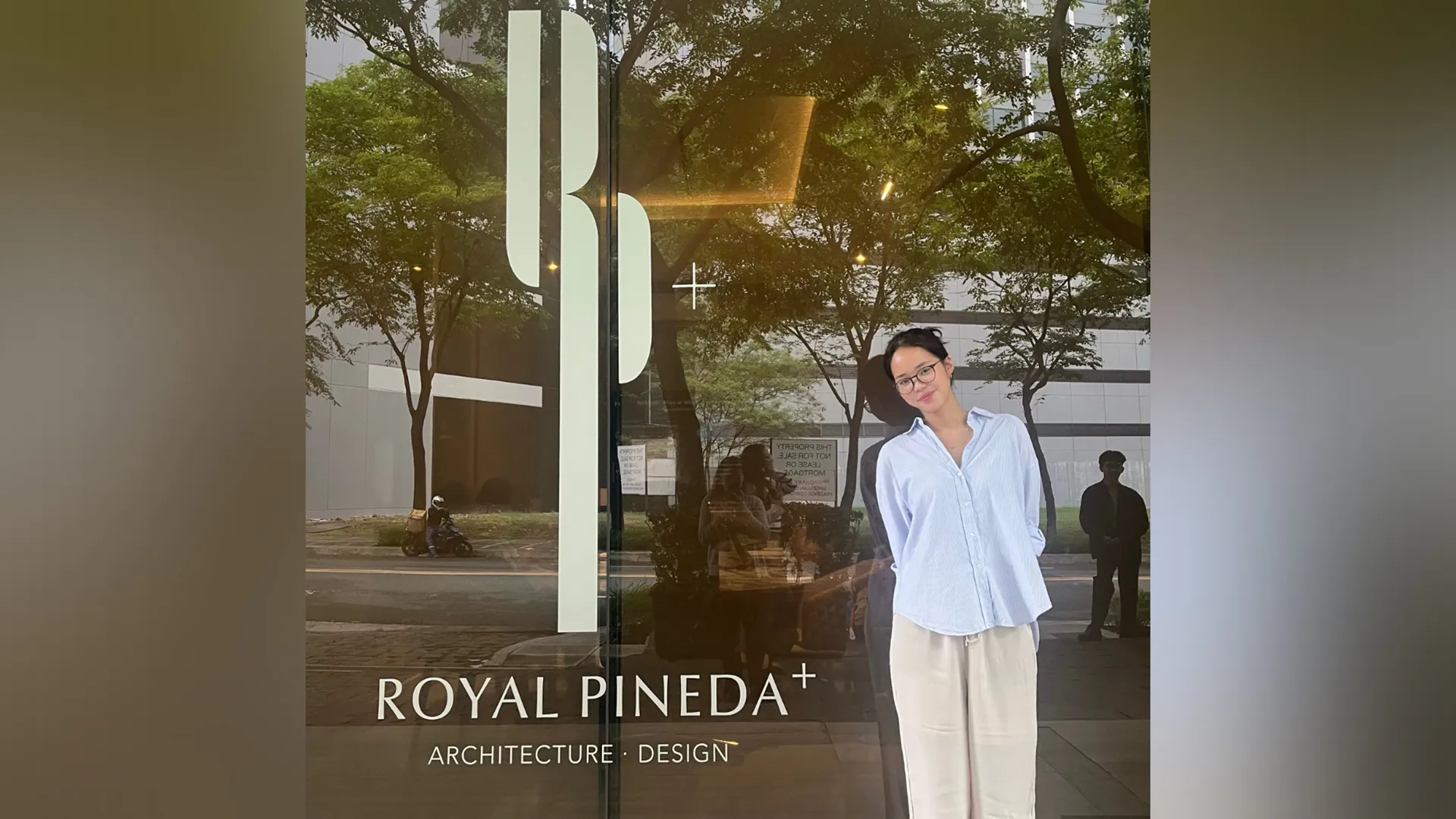
The shower enclosure had disappeared.
It was supposed to be part of the bathroom, but the artificial intelligence tool Juliana Lila Asencio was using had overlooked it. On other occasions, furniture emerged in unusual proportions, walls shifted out of scale, and objects appeared without any apparent relationship to the room.
The images could look convincing at first glance. That did not make them correct.
Juliana learned to compare every generated perspective with the floor plans, site photographs, styling references, and intended design concept. Sometimes, she refined the instructions and regenerated parts of the image. At other times, she corrected the work manually through Photoshop and other design tools.
It was an early lesson from her internship at Royal Pineda+: technology could produce an image, but it could not take responsibility for the space.
“The eye for detail still goes back to the designer,” she said.
For Juliana, then a second-year Interior Design student at Enderun Colleges, the lesson was part of a larger shift in perspective. Over eight weeks, she moved between residential styling, furniture sourcing, AI-assisted visualization, site inspections, working drawings, material presentations, and a civic project of an entirely different scale.
The experience showed her that interior design was not simply about creating beautiful rooms. It was about understanding why a room worked, for whom it worked, and what could go wrong when a decision was made without sufficient attention to the people, materials, systems, and limitations involved.
Finding Her Place in the Room

When Juliana first entered the Royal Pineda+ office, the people around her seemed assured of their place within it.
The studio was filled with experienced architects and designers working across different projects and specializations. Juliana, by comparison, was still early in her education. She wondered whether she had enough experience to keep pace or contribute anything meaningful.
“It felt foreign walking into a professional environment,” she recalled in her internship report. “Everything around felt intimidating.”
Her first assignment placed her with the Interior Design Department on a three-bedroom residential project at Mimosa Golf Ridge. She began by studying the firm’s design philosophy before creating mood boards and styling collages based on the project’s rendered perspectives.
The work gave her a manageable entry into the professional environment, but it was not as simple as selecting attractive furniture and decorative objects. Every piece had to support the concept, fit the scale of the room, remain within budget, and make sense beside everything else.
Juliana initially worried that her selections might not come together. She presented her early progress, received constructive feedback, and made the necessary adjustments. The response gave her enough confidence to continue.
Little by little, the unfamiliar office became a place where she felt able to speak, ask questions, and contribute.
“I learned that being a second-year intern was about finding my own footing,” she said. “With every task and every word of feedback, I felt myself becoming more sure of where I could contribute.”
The Decisions Behind a Beautiful Room
Juliana’s involvement in the residential project expanded from mood boards and styling collages to furniture sourcing, budget preparation, rendered perspectives, wall-finish callouts, and the development of a final concept presentation.
The process revealed how much practical reasoning sits behind a visually coherent interior.
When the initial furniture and accessory selections exceeded the project’s budget, she had to search for more affordable alternatives. The challenge was not merely finding something cheaper. Each replacement still had to preserve the character of the design and meet the functional requirements of the room.
This required patience. It also challenged the assumption that good design is synonymous with expensive design.
A strong interior could not depend on unrestricted spending. It had to find intelligent solutions within real limitations.
Juliana also joined the design team on visits to furniture and materials showrooms. Objects she had previously encountered only through a laptop screen could now be touched, tested, and examined at their actual scale. Materials behaved differently in person. Furniture had weight, texture, proportion, and physical presence.
The showroom visits introduced another dimension of professional practice. Designers needed familiarity with suppliers, products, customization options, and the range of materials available to them. Product knowledge was not separate from creativity. It helped determine which creative ideas could realistically be carried forward.
“For others, it may be a simple task,” Juliana said of furniture and decorative sourcing. “But every choice had to support the concept, work within the space, and make sense with everything around it.”
When AI Gets the Room Wrong
Juliana’s internship coincided with the increasing use of artificial intelligence in architectural and interior design visualization.
At Royal Pineda+, she observed how AI could help refine rendered perspectives, develop atmosphere, and accelerate parts of the visualization process. She was introduced to professional workflows that combined AI tools with established programs such as Photoshop rather than treating one platform as a complete solution.
The work demanded experimentation. A general instruction could produce unwanted changes, so prompts sometimes had to be broken into smaller and more precise steps. Even then, the output required inspection.
AI did not understand that a furniture selection had been made for a particular client, budget, dimension, or way of living. It could reproduce the appearance of a well-designed room without comprehending the decisions that made the room appropriate.
“When selecting furniture, it is not only about finding something that fits the concept,” Juliana explained. “You also have to consider the person’s lifestyle, comfort, budget, function, proportions, and whether the piece actually works within the space.”
The distinction mattered. Visualization could suggest what a room might look like. Design had to determine whether the room could genuinely work.
Her experience presents a more grounded way of understanding AI’s place in creative practice. The technology did not diminish the designer’s role. It made human judgment more important. Someone still had to recognize when the result was inaccurate, impractical, or disconnected from the client and site.
What the Screen Could Not Teach

Site visits gave Juliana a different way of looking at design.
During residential inspections in Makati and Pampanga, she observed architects, engineers, and interior designers examining flooring, wall and ceiling finishes, veneer work, switches, furniture clearances, and other details that affected how the spaces would eventually function.
The technical discussions initially sounded like another language. Different specialists arrived with different priorities, and their decisions had to be coordinated before work could proceed.
Rather than pretending to understand, Juliana asked questions. Her supervisor helped her connect the terminology used in the discussion with what was physically happening on site.
Drawings began to acquire consequence.
A furniture arrangement that appeared balanced in a rendering could obstruct movement when tested against the actual room. Kitchen appliances required sufficient clearances. Finishes had to respond to existing conditions. A decision made by one discipline could create a problem for another.
The experience taught Juliana that design could not be resolved entirely from behind a desk. It also gave practical meaning to the broader question of how interior design shapes human experience. Movement, comfort, safety, and behavior had to be considered alongside visual composition.
“My experience with site visits helped me understand actual scale, existing conditions, movement, and even the way people naturally interact with the space,” she said. “Those are things that cannot always be captured by AI.”
A space had to be encountered, not merely viewed.
From Residential Styling to Civic Responsibility

Later in her internship, Juliana was introduced to the Pasig City Hall project.
The change in scale was immediate. Instead of concentrating on the atmosphere and requirements of a residence, she was now studying extensive floor plans for a public building intended to serve a much larger and more varied group of people.
Her assignment involved assisting with the placement of fire hose cabinets using the fire-protection plan as a reference. The cabinets needed to remain accessible while avoiding obstructions involving high-traffic areas, offices, switches, CCTV equipment, and other building elements.
There was also a visual consideration. Where appropriate, the cabinets could be integrated into the walls and finished consistently with the surrounding surfaces, allowing an essential safety component to sit more coherently within the interior.
The task brought aesthetics and public responsibility into the same conversation.
Juliana and her supervisor reviewed areas where the cabinets could be placed without disrupting movement or compromising their purpose. She studied the drawings, raised questions when locations were unclear, and revised the proposed treatments in response to feedback.
Working on the project changed the way she understood civic interiors. A public building must consider safety, circulation, accessibility, security, durability, and the movement of many different users. Design decisions could not be based on appearance alone.
Her final visit to the Pasig City Hall site took her through eight floors of the development. The plans that had once appeared overwhelming could now be understood as parts of a physical environment shaped by many disciplines and countless coordinated decisions.
The Training Behind the Experience
Juliana entered the internship with experience using AutoCAD, SketchUp, Enscape, Revit, and presentation software through Enderun’s Bachelor of Science in Interior Design. That technical familiarity gave her a foundation for understanding the drawings, models, rendered perspectives, and revisions she encountered at Royal Pineda+.
Yet the internship also revealed that software proficiency was only one part of being prepared.
Organizing work, meeting deadlines, communicating clearly, receiving criticism, remaining attentive to detail, and asking for clarification were equally important. These habits determined whether technical knowledge could be used responsibly in a professional setting.
“It was Enderun that trained me to develop discipline and a good work ethic,” Juliana said, “with my internship giving me the opportunity to use those lessons in a professional environment.”
Her final assignment brought these abilities together. She compiled the styling selections and rendered perspectives for the residential project into a concept presentation, then presented it to her supervisors and the design team as though she were speaking to a client.
She initially worried about how much she needed to explain. The feedback she received was practical: the presentation did not need to account for every object in exhaustive detail. It needed a clear concept and a story that helped the client understand the thinking behind the design.
Communication, she discovered, was part of the design itself.
A Program Measured by What Its Students Can Do
For aspiring students and their parents, Juliana’s experience offers a useful view of what contemporary interior design education can involve.
There were mood boards, styling exercises, and furniture selections, but these were accompanied by budgets, technical drawings, site conditions, safety systems, supplier knowledge, interdisciplinary coordination, deadlines, revisions, and presentations.
Creativity remained essential. It simply had to operate alongside responsibility.
Juliana’s experience also demonstrates the role of interior design internships and industry exposure in helping students understand how academic principles hold up under professional conditions. An internship does not ask a student to arrive as a finished designer. It asks whether that student can observe, adapt, communicate, and contribute responsibly while continuing to learn.
Her experience offers a credible way to consider Enderun’s Interior Design program as one of the country’s emerging programs to watch. The argument does not rest on promotional language. It can be seen in what a second-year student was prepared to encounter and how she responded when her classroom knowledge met professional conditions.
Juliana entered Royal Pineda+ with enough technical preparation to participate, enough discipline to complete her assignments, and enough openness to recognize what she still needed to learn.
The academic training provided the vocabulary and tools. Practice gave those tools weight.
Growth Begins After Entering the Room
By the conclusion of her internship, Juliana had moved through several dimensions of the profession: from styling to technical coordination, from digital images to physical inspections, and from the intimacy of a residence to the responsibilities of a civic building.
She also left with a clearer understanding of the designer she wanted to become.
Interior design, she now argues, cannot be reduced to decoration. Beauty may be the most immediately visible quality of a space, but beneath it are empathy, technical knowledge, material judgment, coordination, revision, and compromise.
A room can be beautiful and still fail the people using it.
Juliana’s accomplishment at Royal Pineda+ was not that she arrived with all the answers. It was that she learned to observe carefully, contribute responsibly, accept feedback, and place her ideas within a process larger than herself.
During the internship, she sometimes questioned whether she was exceptional enough to be surrounded by experienced architects and designers. Eventually, she reconsidered the question.
“I was already in the room,” she reminded herself. “I did not have to know everything yet, as long as I was willing to learn.”
The room that once intimidated her had become a place where she could participate.
For an emerging designer, perhaps that is what earning a seat at the design table really means. Not the assurance that one already knows enough, but the confidence and humility to keep learning once the work becomes real.
Readers who want to study Interior Design at Enderun Colleges may review the program curriculum and learning opportunities. Prospective students may also apply to Enderun Colleges through the online application portal.
Related Stories

Articles
How Do I Stand Out as a Job Applicant with Just a Diploma?
What makes an employer believe you can do the job? Jun Salipsip explores how projects, internships, and lessons from mis...
Articles
The Chefs Behind the Dish You Haven’t Ordered Yet
Meet Enderun alumni Sang Ong, Danielle Tensuan, and Rolfe Salamat, whose culinary R&D careers shape menus at The Moment ...